
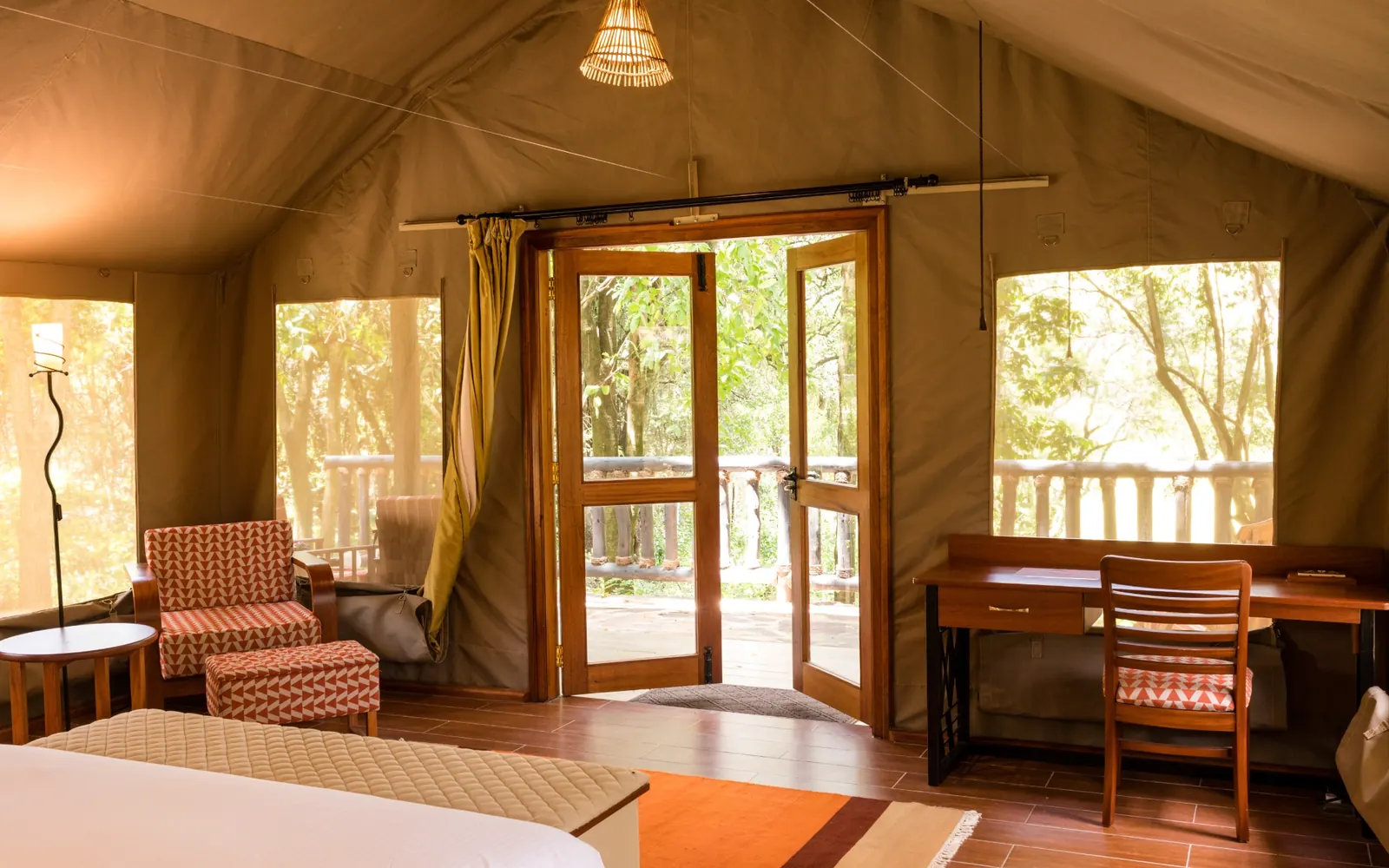
A tented room can have a substantial bed, a private bathroom and carefully planned service. A lodge room can still involve steps, a long walk to dinner or a layout that does not suit your party. “Camp” and “lodge” describe part of the setting; they are not a complete measure of comfort. The more useful comparison is how the room and the wider property will work during your stay.
Begin with the comforts you actually use
Think through an ordinary evening and morning. You return from an outing, wash, charge equipment, find your clothes, walk to dinner and sleep. Which parts need to work particularly well for you?
Someone who sleeps lightly may care most about room position and noise. A family may need bathroom privacy and an internal connection between sleeping areas. A traveller with limited mobility may need a continuous manageable route from vehicle to room to dining area.
Write down these requirements before comparing photographs. This keeps the choice anchored in your needs instead of assuming that one building style is inherently more comfortable.
Ask what is inside the proposed room
| Detail | A question that produces a useful answer |
|---|---|
| Bathroom | Is it private to the room, and how is it separated from the sleeping area? |
| Bed arrangement | Is the quoted room a double, twin, family layout or a room with an added bed? |
| Hot water | What provision and operating arrangement apply to this room? |
| Cooling | What ventilation, fan or air-conditioning is actually provided? |
| Electricity | Where can devices be charged, and are there any supply or equipment restrictions? |
| Storage and space | Where will luggage go without obstructing movement? |
| Outdoor area | Is the veranda or terrace private, shared or overlooked? |
Ask about the quoted category, not just the property generally. A facility shown for one room should not be assumed to exist in every category.
Understand enclosure, sound and the setting
A tented structure may let you hear more of the surrounding environment. The material, screening and room arrangement vary, so ask how the proposed accommodation is enclosed and what that means in practice.
A solid-walled room is not automatically silent. Dining areas, paths, neighbouring rooms, service spaces and other guests can affect how a room feels. For privacy, room position can matter as much as floor area.
If insects, temperature or external sounds are a particular concern, describe the concern directly. Ask what screening and comfort arrangements exist. Avoid treating a polished room photograph as evidence of soundproofing, climate control or an entirely enclosed property.
Look at the route between the room and everything else
The accommodation experience includes the paths you use several times a day. Ask about surfaces, gradients, steps, distance to the dining area and the route from vehicle drop-off to the room.
It can be helpful to request a description or layout image that includes the wider property. A close-up of the bed will not show a raised walkway, an uneven path or a room set well away from shared facilities.
Some wildlife accommodation uses escort arrangements after dark or in other circumstances. Confirm the instructions for the actual property and follow them. “Lodge” should not be taken to mean an urban environment, just as “tented” does not tell you the whole safety arrangement.
Compare service and meal details
Comfort can depend on the operating details that photographs do not show: meal times around outings, dietary arrangements, laundry provision and how requests are handled. Ask which are included and which are available at an additional charge.
If you expect to spend time at camp between drives, consider the seating areas and facilities you will use. A pool matters only if it is actually present, usable for your party and relevant to your stay. Wi-Fi and charging are similarly worth checking if you depend on them, but a facility being listed does not guarantee the performance needed for work or large uploads.
Meal basis also deserves attention. Full board describes meals; it should not be read as an automatic promise of all drinks, private dining or every activity.
Use two room scenarios to test the choice
Imagine a couple choosing between a larger room near the main path and a smaller room in a quieter position. If the room layout and facilities both meet their needs, the quieter location may matter more than additional floor space.
Now consider a family comparing an open-plan family tent with two separately accessed rooms. The extra room area may be welcome, but supervision and access between sleeping spaces could be the deciding factors. Neither example makes one accommodation category universally better.
The purpose of these scenarios is to identify the detail that changes your decision. They are not descriptions of particular properties or evidence that a specific room is available.
Ask for the exact proposed arrangement
Use the accommodation planning guide to understand the broad choices, then ask for the proposed property, room category, occupancy and meal arrangement in your dated quotation.
If an alternative is needed, check whether it preserves the location and features that mattered to your original choice. A similar star description is not a substitute for an appropriate room and setting. Our luxury safari approach places that practical fit alongside time, guiding and service.
Questions about this decision
Does “en-suite” tell me how private the bathroom is?
It indicates a bathroom associated with the room, but not the exact layout or separation. Ask about doors, screening and the arrangement if bathroom privacy is important.
Is a lodge always easier for someone who finds steps difficult?
No. The specific paths, room access and bathroom layout matter. Check the proposed room and the routes to shared facilities.
Can I assume a premium camp has air-conditioning or reliable Wi-Fi?
No. Confirm the actual cooling and connectivity arrangements, particularly if they are essential to your comfort or plans.