
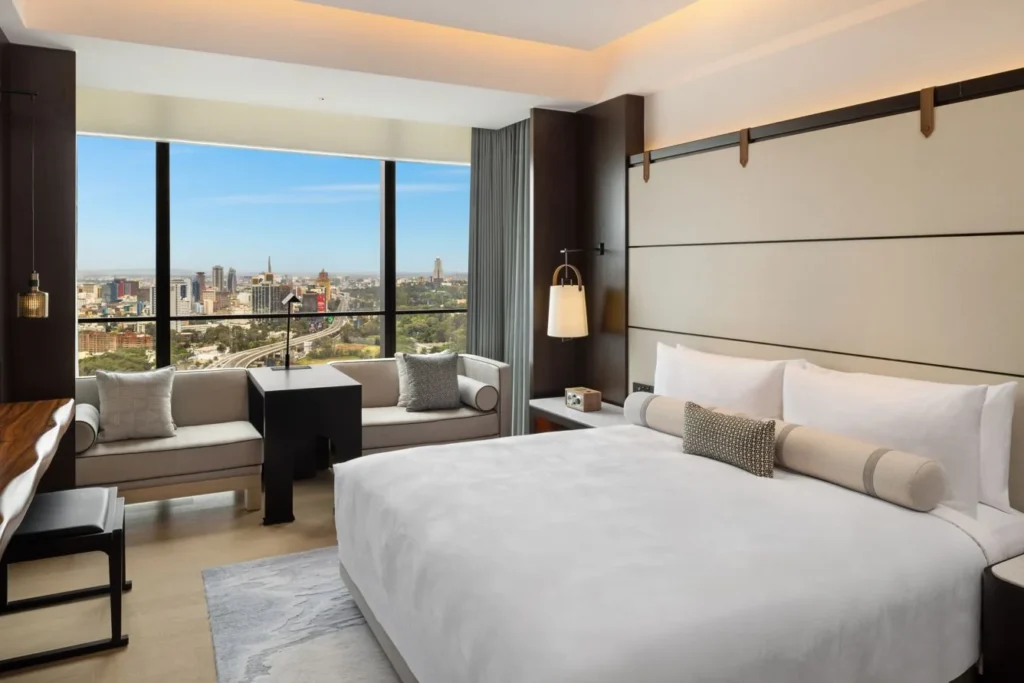
“A family room, please” can mean very different sleeping arrangements. Some families want everyone in one space; others need separate beds and a connecting door, or a quiet room for an early bedtime. Describe who will sleep where before choosing the label. That gives the accommodation provider something precise to confirm.
Start with every traveller and every bed
Give the number of adults and children, the children’s ages on the travel dates and the number of rooms requested. Then describe the preferred bed arrangement for each room.
For example, a family of two adults and two children might request one adult sleeping area and two separate child beds, or two rooms with an internal connecting door. Those are different requests, even though both could be described informally as “family accommodation”.
State whether a shared bed, sofa bed or rollaway would be acceptable. If one arrangement is essential and another is a fallback, mark that distinction. It helps avoid a quotation based on a solution you would never use.
Translate room labels into a physical arrangement
| Term in a proposal | What to confirm before relying on it |
|---|---|
| Double room | The bed arrangement, dimensions if important and permitted occupancy |
| Twin room | Two separate beds and whether that configuration is confirmed |
| Family room or suite | Actual sleeping areas, beds, doors and bathroom arrangement |
| Extra bed or rollaway | Who may use it, its suitability and the effect on usable room space |
| Sofa bed | Whether it is made up for the stay and suitable for the intended traveller |
| Cot | The actual cot provision, availability and any relevant age or size conditions |
| Connecting rooms | An internal door between the rooms, if that is what you require |
| Adjacent or nearby rooms | The exact proximity; these words do not confirm an internal connection |
Property terminology varies. Ask for the arrangement to be described in plain language rather than assuming the room-category name answers every question.
Make an essential connection part of the booking decision
If an internal door is essential, say so at the beginning. “Connecting rooms requested” and “connecting rooms confirmed” are different states.
Ask how the property treats the ages and occupancy of children in a separate room. Do not infer that a child may occupy a room alone because two rooms are available. The provider needs to confirm an acceptable arrangement for your family.
A floor plan or verified photograph can help you understand the layout, but it does not hold that room or establish its availability for your dates. The dated quotation and subsequent booking confirmation should make the agreed configuration clear.
Consider the hours outside bedtime
For Nairobi, think about the room during an early arrival or a rest period between travel days. A larger room is not useful for that purpose if access begins after the time you need it.
On the coast, consider whether the family wants somewhere to sit while a child sleeps, and whether everyone is comfortable with the proposed bathroom and terrace arrangements. Ask about the actual location of the room if stairs, distance from meals or other access needs matter.
Noise preferences and daytime rest are reasonable parts of the brief, but exact quietness cannot be guaranteed. Explain the practical need so the provider can assess a suitable available option.
Match the meal basis to the actual occupancy
Ask which meals are included for each traveller and how the proposed room arrangement affects the quotation. An accommodation description should not leave you guessing whether a child’s meals or an additional bed are covered.
Do not assume that a child is free, charged at a particular percentage or treated as an adult based on a generic age category. Use the property’s current rule and the ages on your dates.
For an early departure or late arrival, check whether the stated meal basis produces the meal you will actually need. A breakfast-inclusive stay does not by itself confirm a breakfast before an unusually early pickup.
Send a room brief that can be confirmed
For Hotel Reservations, send the destination, check-in and checkout dates, rooms, travellers and ages, preferred standard, exact sleeping arrangement and meal priorities. Identify essential needs before optional preferences.
Ask the quotation to record the proposed property, room category, occupancy, beds and meals, together with the availability status. If an alternative is proposed, compare its layout and location as well as its standard.
For the wider journey, the Family Safaris page helps connect room choices with pace, private vehicle requirements and rest. Where the question concerns sleeping inside a safari tent rather than an urban or coast property, use the separate guide to one family tent or two safari rooms.
Questions and answers
Are two nearby rooms equivalent to connecting rooms?
No. If you need an internal connecting door, ask for that exact arrangement and its confirmation. Nearby rooms may still require using a corridor or outdoor route.
Should I give children’s current ages or their ages when travelling?
Give their ages on the travel dates. Those are the ages the provider needs when assessing occupancy and the applicable arrangement.
Can a family-room photograph confirm the beds we will receive?
It can help explain a verified layout, but it is not a booking confirmation. Ask for the actual room category, bed arrangement and availability in writing.