
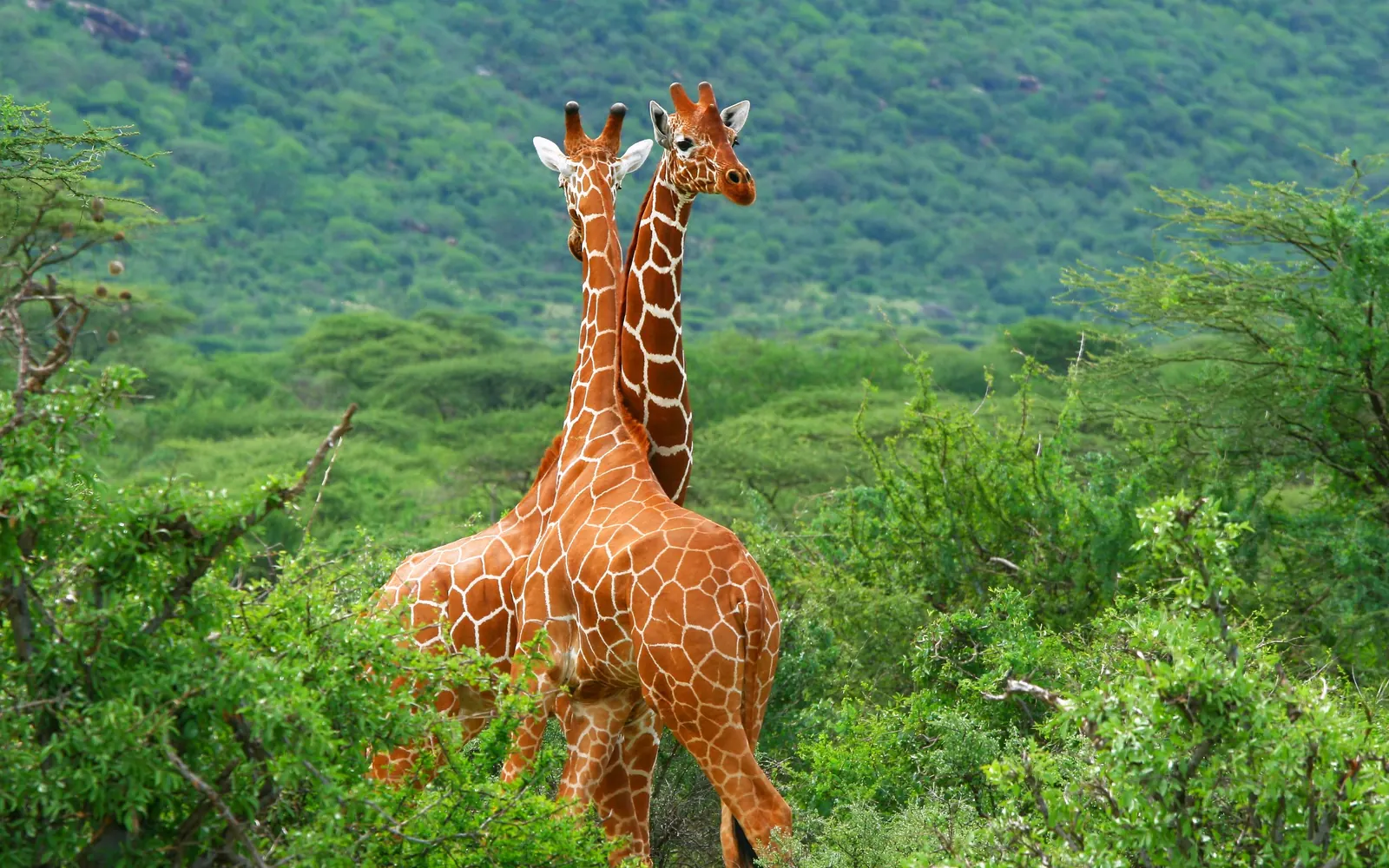
The name “reticulated” refers to a network. On a reticulated giraffe, pale lines separate coloured patches in a pattern that can look strikingly geometric. Seeing that pattern in the northern Kenyan landscape is a good starting point, but there is more to notice than the coat: how the animal uses the vegetation, how much space surrounds it and what your view does—or does not—reveal.
Read the pattern in a clear view
Reticulated giraffes typically show orange-brown patches divided by a distinct network of pale lines. The pattern is an important visual clue, especially when the side of the neck and body are visible.
Light can change the apparent colour. Shade, a warm evening or an overexposed photograph may make the same coat look different. Look at the arrangement of the lines and patches rather than relying only on whether the animal appears dark or pale.
Ask the guide to explain the identification from the animal in front of you. A partly hidden head or a distant silhouette may not show enough detail, and a photograph’s filename is not a substitute for identification.
Use current names without making taxonomy the whole outing
The four-species classification recognised by the IUCN’s giraffe specialist group treats reticulated giraffe as Giraffa reticulata. Older books may use a different arrangement or describe it within a single giraffe species.
That explains why references can appear to disagree even when discussing the same familiar animal. Taxonomy and conservation status are separate questions; a change in the classification does not by itself supply a new population count or threat assessment.
You do not need to settle scientific terminology during a drive. Use a current identification reference and spend the rest of the observation looking at the animal and its setting. The name is useful because it helps you recognise a particular part of Kenya’s wildlife diversity.
Understand why the northern setting matters
Reticulated giraffes occur mainly in northern and northeastern Kenya. Their habitat also extends beyond government-managed protected areas, which is one reason the broader landscape matters to their conservation.
For a traveller, that is a reason to look beyond a reserve name. The Samburu destination guide describes one relevant safari region; it does not imply that every reticulated giraffe lives inside the same reserve or that every northern stay provides the same access.
Ask where the proposed accommodation sits and what area your drives explore. Location gives context to the observation, without making an encounter certain.
Let ordinary behaviour hold your attention
If a giraffe is feeding, watch which parts of the vegetation it reaches and how its position changes. If several animals are visible, notice the distance between them rather than immediately assigning each one a family role.
Keep observation and interpretation separate. You may see an animal turn its head, pause or move away; those are things you can describe. Its precise reason may be less clear. Ask the guide what can reasonably be inferred and what remains uncertain.
A short period of attentive watching can make familiar behaviour interesting. It does not require a dramatic interaction, a calf or a close approach. Nor should waiting become an attempt to make the animal behave for the vehicle.
Make photographs that explain the setting
| Photograph | What it can communicate | What to check |
|---|---|---|
| Side view with neck and body | The coat pattern and overall form | Do not crop away all the features needed for identification |
| Wider landscape frame | The relationship between animal, vegetation and open space | Retain a truthful sense of distance |
| Feeding detail, if visible | An action actually observed | Do not caption a pause as a behaviour you did not see |
| Several giraffes in one frame | Spacing and the shared setting | Avoid inventing family relationships or individual identities |
Work from the guide’s permitted position. A clear background is not a reason to ask for an intrusive approach. If vegetation partly hides the animal, that may simply be the view available that day.
Ask about the landscape without inventing an impact story
You may encounter descriptions of habitat protection or community involvement while planning a northern safari. Ask what is documented for the specific place or programme being discussed.
A giraffe sighting does not prove that your booking has funded a particular conservation result. Equally, a quiet drive does not establish that conservation has failed. Those conclusions require information beyond one visitor’s experience.
For a broader route, use the destinations guide to compare settings. An interest in reticulated giraffes can help define the northern chapter, alongside the landscape and guiding you want, without making one species responsible for the success of the whole stay.
Questions and answers
Why does an older guidebook use a different scientific name?
Giraffe classification has changed as evidence has developed. Current four-species treatment recognises reticulated giraffe as Giraffa reticulata; older references may reflect an earlier classification.
Can the coat alone identify an individual giraffe for me?
Do not assign an individual identity from a casual comparison. A species-level identification and a documented individual identification are different tasks.
Will a Samburu stay guarantee a reticulated giraffe sighting?
No. The region provides relevant habitat, but wildlife movement and visibility vary. Plan for the wider experience as well as particular interests.