
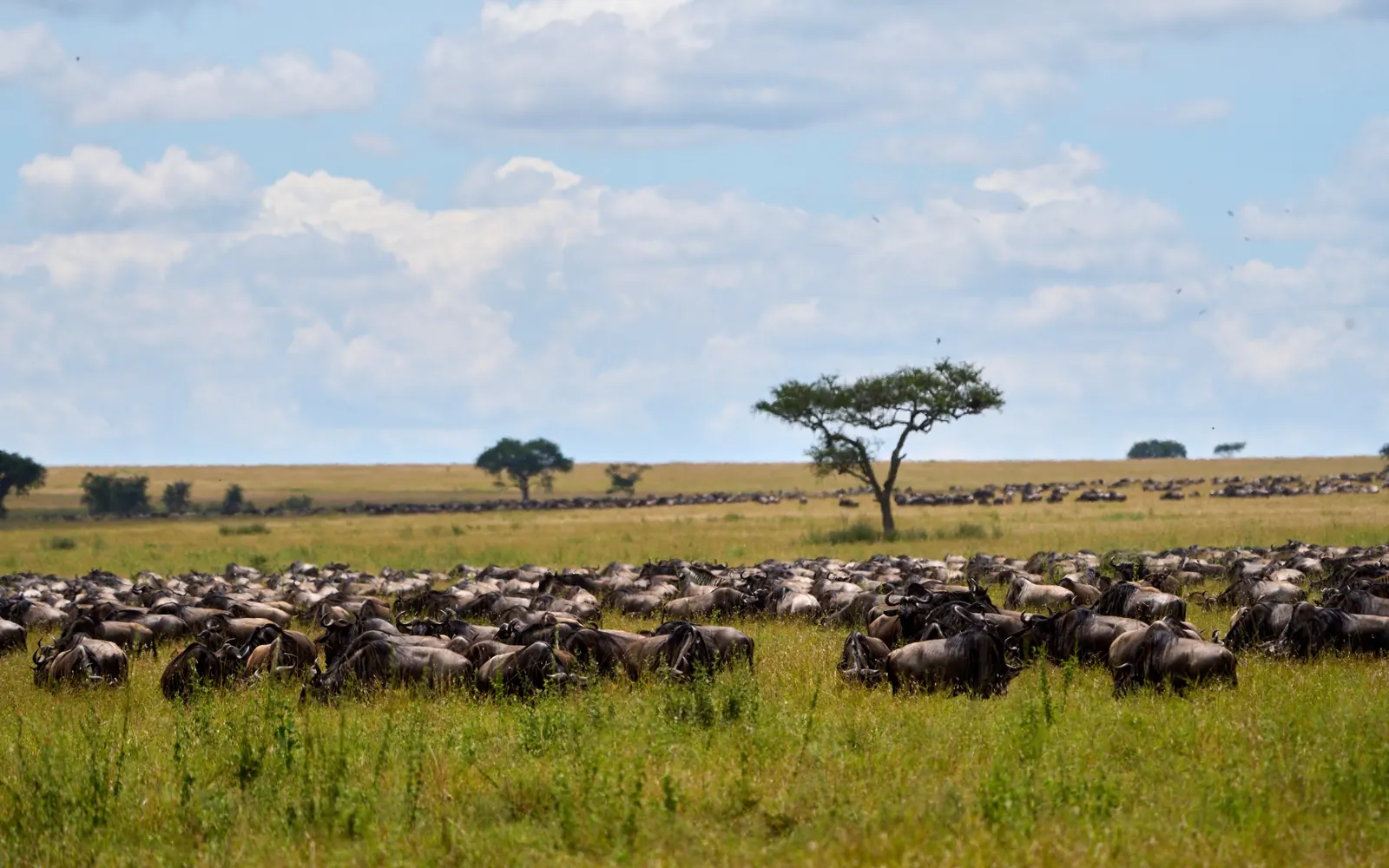
You can visit the Mara during a period associated with the Great Migration and never see a river crossing. The animals may be elsewhere, may remain near a river without crossing, or may move when you are not there. That uncertainty belongs in the planning conversation before you travel.
A rewarding migration safari needs more than a hoped-for event. It needs time in the landscape, a guide who can explain what is happening, and an itinerary you would still value if the river remains quiet.
The migration is larger than one riverbank
The Great Migration belongs to the wider Serengeti–Mara ecosystem, spanning Kenya and Tanzania. Movement responds to grazing, rainfall and water, so broad seasonal patterns should not be treated as an appointment calendar. Tanzania National Parks identifies the migration and Mara River as conservation priorities within that wider ecosystem. TANAPA migration-viewing guidance
The Great Migration planning guide is the place for the broader seasonal context. When shaping an actual visit, ask what is reasonably expected for your dates while accepting that exact herd positions and crossing times cannot be guaranteed.
A crossing is one possible moment within a much larger movement. It is not a separate activity that an operator can book on your behalf.
Decide how much waiting you actually want
Watching and waiting may be part of a wildlife outing. Some travellers are content to spend a long time observing a herd’s movement. Others would rather explore different areas than remain in one place with an uncertain outcome.
Discuss that preference with your planner and guide. Families, photographers and mixed-interest couples may give very different answers. A private vehicle may allow more control over your party’s day, within access rules and agreed arrangements; it does not allow a guide to make animals cross.
Agree how decisions will be made if there is an opportunity to wait. For example, you might want the guide to explain the options and their trade-offs before committing a large part of the day. Avoid setting a rule that encourages pressure on wildlife to justify the time spent.
Look at the herd away from the river
A migration visit can involve the scale of animals across grassland, the sound and movement of a herd, or a closer look at grazing and social activity from an appropriate position. Those experiences do not need a crossing to give them meaning.
Ask your guide to explain the setting and what is observable that day. The answer may involve where animals have been seen, how conditions are affecting the route, or why a particular area is worth exploring. Treat it as current field judgement rather than a promise for the next outing.
The wider Mara also has wildlife and landscape interests beyond the migrating herds. Do not reduce the destination to a single seasonal spectacle or assume that its value ends when the herds move elsewhere.
Choose accommodation for a worthwhile stay
A camp’s position can influence access to the areas you want to visit. It cannot guarantee that wildlife will be near a particular point during your stay.
Ask how the proposed base works for ordinary drives as well as migration-focused outings. What happens if the most interesting viewing is elsewhere? How long might a full-day outing feel? Which access arrangements and charges are included?
Our Mara reserve and conservancy stay comparison helps separate accommodation location from vague destination labels. A balanced proposal should explain why the base suits the whole visit, not only a crossing photograph.
Give the trip more than one measure of success
Before travelling, choose a few interests that do not depend on a single event. They might include time observing elephants, understanding a grassland landscape, wildlife photography in different light, or sharing unhurried outings with family.
These are interests, not guaranteed inclusions. The point is to arrive curious about more than one outcome. If the day’s best opportunity is away from the river, you can make that decision without feeling that the entire safari has failed.
| If this matters most | Discuss before travel |
|---|---|
| Seeing large herds | Broad seasonal suitability and the uncertainty of exact positions |
| Photography | Time, vehicle arrangements and patience without crowding animals |
| A family experience | How long everyone is comfortable waiting |
| Variety | A plan that values the wider Mara as well as migration activity |
Responsible viewing is part of the experience
Crossing locations can attract attention from many visitors. Follow the current rules and your guide’s instructions. Do not ask for an approach that blocks animals, leaves authorised routes or interferes with movement.
Rules differ across jurisdictions. Guidance issued for Serengeti National Park should not be presented as the legal rulebook for the Kenyan reserve. Your operator and guide must work to the requirements of the actual location being visited.
The wildlife has priority over a desired image. A decision to hold back, reposition appropriately or leave can be the right one even when it is disappointing.
Ask a better question when enquiring
Instead of “Can you guarantee a crossing?”, ask: “How would you plan a rewarding Mara stay for these dates if no crossing happens?” The answer should discuss the base, available time, daily flexibility and other interests.
Explore the Maasai Mara destination page and describe what you hope to experience. Magical Exploits can help shape the journey around those priorities while keeping the uncertainty of wildlife clear.
Questions travellers ask
Can I book a specific river-crossing day?
No. You can arrange a safari during a broadly suitable period, but animal movement and crossing timing cannot be reserved or guaranteed.
Does staying longer guarantee a crossing?
No. More time may provide additional opportunities to explore and observe, but it does not remove uncertainty.
Is the Mara worthwhile outside the migration focus?
Yes, its appeal includes landscapes and wildlife beyond the migrating herds. Choose dates and a route around your wider interests, with realistic expectations about conditions and sightings.
Should we spend every day waiting by the river?
That is a preference to discuss, not an automatic requirement. Consider the group’s patience, current conditions and what else you would like to experience, while following the rules at each location.