
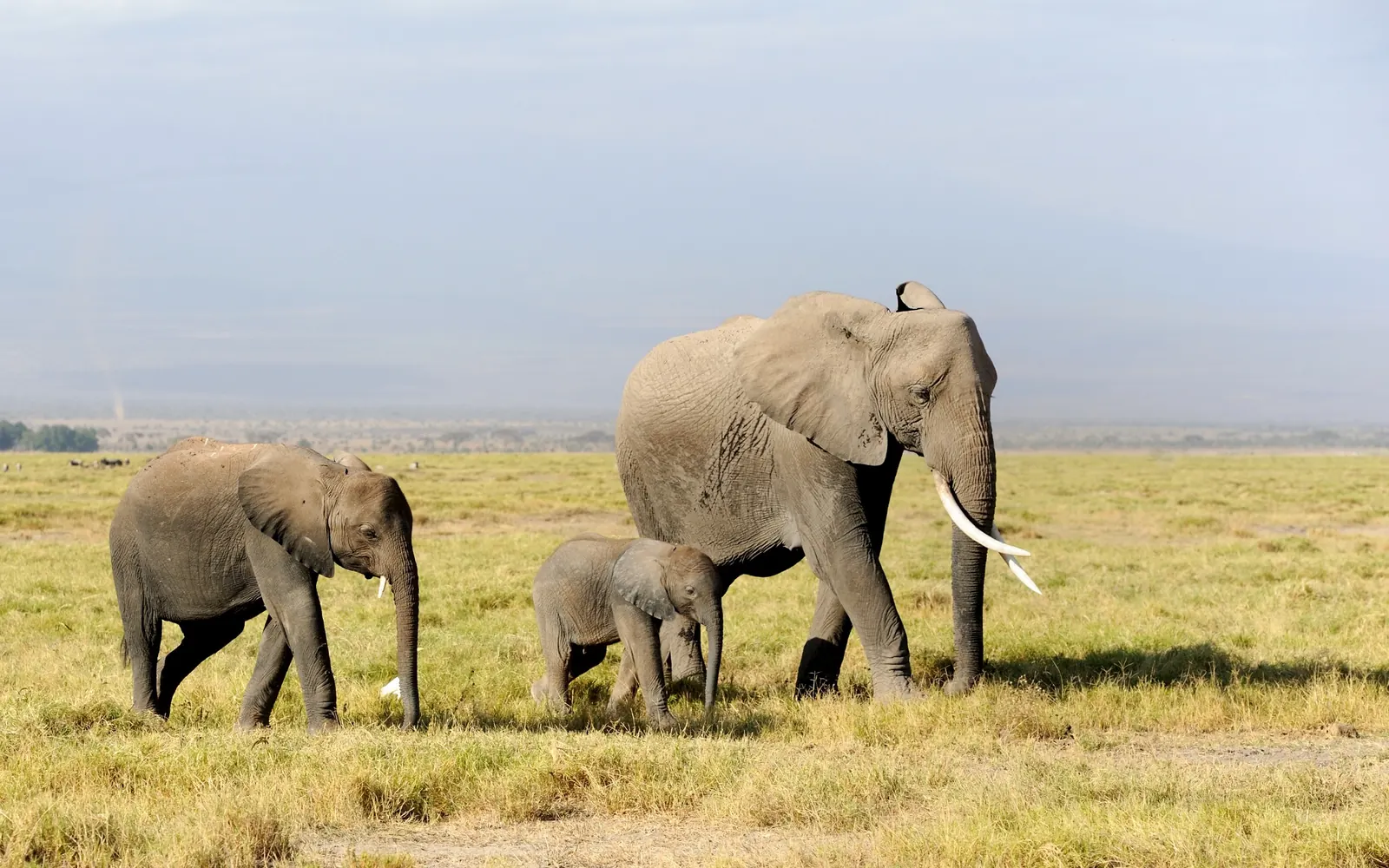
An elephant encounter can become more interesting when you stop trying to make it closer. From an appropriate viewing position, you can watch how animals move through a setting, use their trunks, feed and respond to one another. The detail is often in the sequence, not the distance.
Let the guide manage the vehicle and the viewing position. Your role is to observe, ask useful questions and avoid creating pressure for an animal to perform, approach or change direction.
Begin with the whole scene
Before zooming in, look across the group and the landscape around it. Are the animals spread out or moving together? Is there a clear direction of travel? Are some feeding while others pause?
Notice open space as well as animals. An empty part of the frame may be the direction in which they are moving. A photograph that keeps that space can explain more than a tightly cropped portrait.
Do not ask the driver to occupy an animal’s route for a better angle. An attractive sighting is not a reason to block movement or separate individuals. Follow the guide’s instructions and the applicable viewing rules, including when the best decision is to leave.
Watch an action long enough to see its sequence
Choose one visible activity rather than trying to follow everything at once. An elephant may gather vegetation, adjust it with its trunk and bring it to its mouth. Watch the sequence and ask what the guide can identify from the position you have.
A trunk touching another elephant, an ear movement or a change in posture can invite questions, but one gesture is not a complete translation of what the animal is feeling. Context matters. ElephantVoices’ Elephant Ethogram documents a wide range of behaviours and is a useful learning resource before or after a safari.
Avoid turning a quick online description into your own field safety assessment. Knowing the name of a behaviour does not tell you that it is safe to approach or remain in place.
Ask better questions about groups
Instead of asking only, “How many are there?”, try asking what can be observed about the group. Are there calves? Do individuals appear to be moving together? What can be said with confidence, and what would require knowing the animals over time?
Long-term research can reveal relationships that a visitor cannot infer from a brief sighting. The Amboseli Trust for Elephants describes enduring social bonds and the importance of older elephants’ knowledge. That is a reason to respect the complexity of what you are seeing, rather than inventing a family story for every photograph.
Do not assign names, relationships or personal histories to particular elephants unless a reliable source supports them. A guide saying “we do not know” can be a careful answer, not a failure of expertise.
Keep observation separate from interpretation
A useful habit is to describe first: “The calf moved between two adults,” or “The animal stopped feeding and turned.” Then ask the guide about possible explanations.
Statements such as “she is posing for us” or “he wants to play with the vehicle” may sound appealing, but they turn human impressions into claims. A wild animal’s approach should not be encouraged for entertainment.
The same care improves photography captions. Describe what is visible rather than adding an emotional story the image cannot prove. “Elephants moving across open ground” can be more truthful than an elaborate account of why they are moving.
Use equipment to reduce pressure, not create it
Binoculars can make a distant sighting absorbing. Share them carefully without leaning outside the permitted position or distracting the driver. If several people use one pair, agree a simple turn-taking arrangement before the next stop.
For cameras, choose a composition available from where the vehicle can responsibly remain. A longer lens is useful only if you can use it steadily and considerately. Large equipment should not block another traveller’s view or become a reason to demand a closer approach.
Give yourself some time without a screen. You may notice movement and interaction more easily when you are not constantly reviewing the last photograph.
Make the encounter work for children too
A quiet observation challenge can help: find an elephant feeding, watch how a trunk is used, or notice whether the group is moving in one direction. Keep it simple and avoid asking children to predict what an animal will do next.
Explain beforehand that seeing animals does not mean calling to them, offering food or trying to attract attention. If the guide asks everyone to be quiet or sit down, that instruction takes priority over finishing a photograph.
A child’s attention may fade before an adult photographer is ready to leave. A family safari day with sensible breaks helps reduce that conflict without turning the animal encounter into a performance.
Leave room for encounters to end
A good sighting does not have to last until every traveller has an identical photograph. Animals may move out of view, conditions may change, or the guide may decide the position is no longer suitable.
Use the experience as a starting point for learning. Amboseli and Samburu offer different contexts in which elephants may be encountered. Neither destination can promise a particular individual, behaviour or distance.
Questions travellers ask
How close should we get to elephants?
There is no universal distance recommendation in this article. Follow the rules for the location and your guide’s judgement. Conditions, animal behaviour and available space all matter.
Does an elephant coming towards us mean it is comfortable?
Do not make that assumption. Stay in the instructed position and let the guide manage the situation. An approach is not an invitation for contact.
Is a distant sighting worth stopping for?
Often it is. Binoculars, a wider landscape view and patient observation can reveal movement and behaviour without requiring a close encounter.